Sunday, 26 April 2020

Reworking some old data


MY processing skills with LRGB are definitely improving in fits and starts, so I have gone back to  some of the old data and reworked it. Originally, the main problem was lack of colour.

Now, the processing is:
Register, align and stack as separate channels in DSS
Stretch (levels and curves) each channel in PS
Combine the R,G and B, adjust using Histogram to give same pseudo white point
Saturate
Add the Luminance channel, use Luminosity as blend mode.
IF necessary, try using HLVG
Import the LRGB into Lightroom and improve

NGC4565


Sunflower galaxy

Globular Clusters and a 'Lost in Space' galaxy

I wanted to 'flit about' so took about 45 mins L on M3 and 15 o RGB, al lat 114 s exposures. After that ,  I had a look at half a dozen other objects, mainly globular cluster, plus one galaxy with the name 'Lost in Space ' galaxy in Draco - worth a better look sometime.  The globular cluster were a single exposure at 240s; the galaxy is based on 14 mins.

Used the M3 data to try a different way of colour processing - stretch all the channels before combining, colour balance RGB before adding luminance, use the Histogram tool in PS - seems better I think.

M3

M5

M53

NGC4147

NGC5053

NGC5466

NGC 5634

NGC 6503

Friday, 24 April 2020

NGC 4559

This is based on 114s exposures:
L 70, R 35, G 35, B 31

A problem that has occurred three times no; following the meridian flip, the mount will plate solve but not sync (Cannot sync to coordinates, exception occurred). I have asked for help in the APT Forum.

NGC 4559 in Coma Berenices

Plate solve from Astrometry


Wikipedia:
NGC 4559 (also known as Caldwell 36) is an intermediate spiral galaxy with a weak inner ring structure in the constellation Coma Berenices. Distance estimates for NCG 4559 range from about 29 million light-years to 51 million light-years, averaging about 29 million light-years.

NGC 4559 is a member of the Coma I Group.

Two supernovae have been recorded in NGC 4559, A Type II-L supernova in 1941 (SN 1941A) and an unclassified supernova event in 2019.

In 2016, a luminous blue variable experienced a supernova-like outburst in NGC 4559, designated AT2016blu.

Wednesday, 22 April 2020

Another Hunting Dog - NGC 4395

This is another galaxy in the constellation Canes Venatici. The image is based on 180s exposures:
 L 46, R 25, G 20, B 24

The galaxy is fairly dim (10.6). There is a lot of noise, I have stretched it a lot and clearly the SNR is pretty low. The trouble is, its April and the Astronomical Night is now getting pretty short. I can image between round 10 pm and 4 am.

NGC 4395

Wikipedia: NGC 4395 is a low surface brightness spiral galaxy with a halo that is about 8′ in diameter. It has several wide areas of greater brightness running northwest to southeast. The one furthest southeast is the brightest. Three of the patches have their own NGC numbers: 4401, 4400, and 4399 running east to west. The nucleus of NGC 4395 is active and the galaxy is classified as a Seyfert. It is notable for containing one of the smallest supermassive black hole with an accurately-determined mass. The central black hole has a mass of "only" 300,000 Sun masses, which would make it a so-called "intermediate-mass black hole".

Tuesday, 21 April 2020

Focusing on Messier 63

The focus control on a Schmidt Cassegrain is a small knob on the back of the telescope; when you touch it, the whole thing vibrates, image shakes and focusing is not easy. So I have bought a Celestron Focus Motor.

Fitting it was very straight forward, the motor came with all the adjusters needed to replaced the manual focus. I managed to leave out a tightening grub screw which meant that at first, when the motor turned, the focus knob didn't, but once the crew was tightening, everything worked.

The software was the biggest nuisance. Celestron has a new combined scope/focuser driver but that didn't work. The older driver seemed ok but the utility kept disconnecting when I was trying to run a calibration. In the end, running it from within Astrophotography Tool (APT) seemed to cure all ills.

I have made a bigger Bahtinov mask that can fit over the dew shield, making it easier to check focus that way. There is a utility in APT which helps you check whether focus si sharp with the Bahtinov mask on. So, I have tried using this, as well as the Focus Aid and Auto Focus Aid in APT. The point of focus seemed very similar. I have also entered focus offsets for the different filters, which APT will apply automatically as each type of filter is used. I have yet to check the R, G and B offsets via the Bahtinov mask though.

So, this is the first image made with the new focus motor attached. Focusing was easier, though it is a bit of a slow process at the moment due to my inexperience.

This image of Messier 63, the Sunflower Galaxy, is based on the following subs, all at 180s:

44 L
25 R
20 G
22 B
Darks, Flats and Dark Flats were used for calibration.
L and RGB were processed separately in PS. On combining the two, all I did was to use Hasta LA Vista Green filter, which seemed more effective than trying to Colour Balance.

Messier 63 The Sunflower Galaxy
APOD:   A bright spiral galaxy of the northern sky, Messier 63 is about 25 million light-years distant in the constellation Canes Venatici. Also cataloged as NGC 5055, the majestic island universe is nearly 100,000 light-years across. That's about the size of our own Milky Way Galaxy. Known by the popular moniker, The Sunflower Galaxy, M63 sports a bright yellowish core.  Its sweeping blue spiral arms are streaked with cosmic dust lanes and dotted with  star forming regions. A dominant member of a known galaxy group, M63 has faint, extended features that are likely star streams from tidally disrupted satellite galaxies (just visible in the lower bottom right of the galaxy). M63 shines across the electromagnetic spectrum and is thought to have undergone bursts of intense star formation.

Thursday, 16 April 2020

Three Comets

Currently there are three comets visible in the Northern Hemisphere. One C/2019 Y4 Atlas was hoped to become a real stunner but seems to have fragmented in the last week and has dimmed somewhat, currently at magnitude 9.4. The other two, C/2019 Y1 Atlas (9.6)and C/2017 T2 Pannstarrs (8.7) are not expected to become naked eye objects.
I have taken 240 s exposures, calibrated with flats and dark flats and created gifs from the unstacked  stretched frames. (DSS, Lightroom and a gif maker).

The 2019 Y1 and 2017 T2 seem much brighter than 2019 Y4;  the magnitudes were from the information pane in Cartes du Ciel, after I had updated the comet information last night. I imagine it shows the ongoing fragmentation of Y4.

C/2017 T2 Pannstarrs

C/2019 Y1 Atlas

C/2019 Y4 Atlas

Wednesday, 15 April 2020

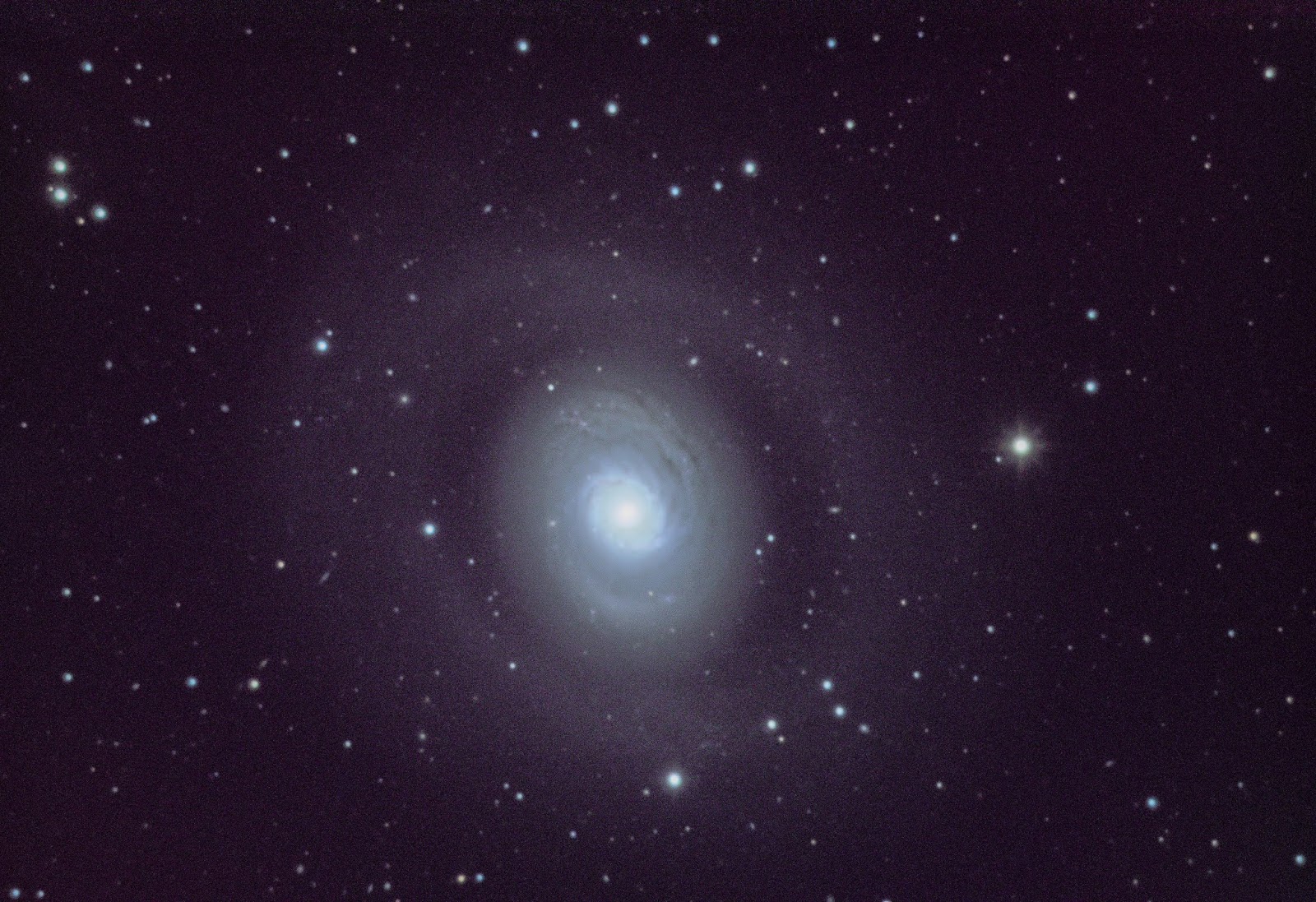
Messier 94

This image is based on:
L 56 x 180s
R 25 x 180s
G 20 x 180s
B 23 x 180s
Gain 139 and offset 21
When it was registered and stacked, I had 2 x drizzle turned on. I will  process it normally as well, eventually.

The outer ring is fairly visible, though the image would benefit from a few more hours exposure.

M94 in Canes Venatici 2 x drizzle
Wikipedia: Messier 94 (also known as NGC 4736) is a spiral galaxy in the constellation Canes Venatici. It was discovered by Pierre Méchain in 1781, and catalogued by Charles Messier two days later. Although some references describe M94 as a barred spiral galaxy, the "bar" structure appears to be more oval-shaped. The galaxy has two ring structures.