Friday, 23 April 2021

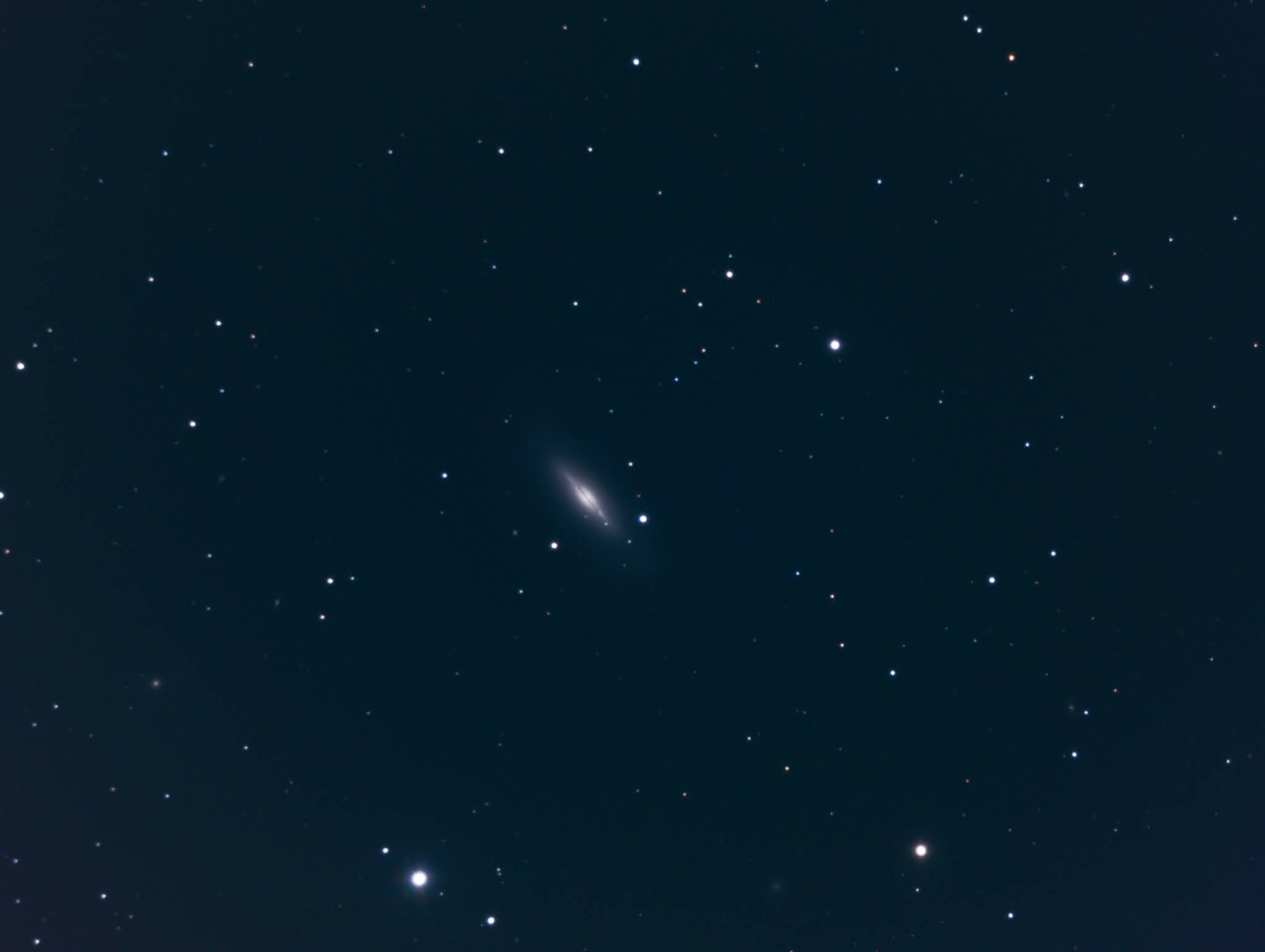
NGC 5866 The Spindle Galaxy


I have bought a new bahtinov mask in order to try and improve the focus. The mask was 3D printed and has finer slits than my old (home made) one. The diffracted image of the star was definitely sharper and I was able to get a point of focus where the value wobbled around  the 'in focus' value.

L : 74 x 114 s (2hrs 20min) , 139 gain, 1x1

R: 23 x 114 s (41min), 139 gain, 1x1

G:23 x 114 s (41min), 139 gain, 1x1

B:25 x 114 s (45min), 139 gain, 1x1


Wikipedia:

NGC 5866 (also called the Spindle Galaxy or Messier 102) is a relatively bright lenticular galaxy in the constellation Draco. NGC 5866 was most likely discovered by Pierre Méchain or Charles Messier in 1781, and independently found by William Herschel in 1788. Measured orbital velocities of its globular cluster system[5] imply that dark matter makes up only 34±45% of the mass within 5 effective radii; a notable paucity.

One of the most outstanding features of NGC 5866 is the extended dust disk, which is seen almost exactly edge-on. This dust lane is highly unusual for a lenticular galaxy. The dust in most lenticular galaxies is generally found only near the nucleus and generally follows the light profile of the galaxies' bulges. This dust disk may contain a ring-like structure, although the shape of this structure is difficult to determine given the edge-on orientation of the galaxy. It is also possible that the galaxy is a spiral galaxy that was misclassified as a lenticular galaxy because of its edge-on orientation, in which case the dust lane would not be too unusual.

NGC 5866 is one of the brightest galaxies in the NGC 5866 Group, a small galaxy group that also includes the spiral galaxies NGC 5879 and NGC 5907. This group may actually be a subclump at the northwest end of a large, elongated structure that comprises the M51 Group and the M101 Group, although most sources distinguish the three groups as separate entities.

Saturday, 17 April 2021

The Hairy Eyebrow Galaxy, NGC 4526 and M98

 These were imaged across two nights, trying ot get subs from 9pm till 5 am on both. Usual settings, with L being 3 times the total for RG and B, all at 1x1, bias 139 and 114s subs. 

NGC 4526 L:3hr 11 min  RGB around 1 hr


M98 : L 3hr 27 min  RGB around 1hr 10 min

          104 x 114 s


The main difference from recent images is that I have added a focal corrector again, so instead of being at F10, the scope is at F6.3, images should be flatter with less coma and a larger FOV.


Wikipedia: NGC 4526 (also listed as NGC 4560) is a lenticular galaxy located approximately 55 million light-years from the Solar System in the Virgo constellation and discovered on 13 April 1784 by William Herschel.

The galaxy is seen nearly edge-on. The morphological classification is SAB(s)0°,which indicates a lenticular structure with a weak bar across the center and pure spiral arms without a ring. It belongs to the Virgo cluster and is one of the brightest known lenticular galaxies.

The inner nucleus of this galaxy displays a rise in stellar orbital motion that indicates the presence of a central dark mass. The best fit model for the motion of molecular gas in the core region suggests there is a supermassive black hole with about 4.5+4.2−3.0×10⁸ (450 million) times the mass of the Sun. This is the first object to have its black-hole mass estimated by measuring the rotation of gas molecules around its centre with an Astronomical interferometer (in this case the Combined Array for Research in Millimeter-wave Astronomy).


Wikipedia: Messier 98, M98 or NGC 4192, is an intermediate spiral galaxy about 44.4 million light-years away in slightly northerly Coma Berenices, about 6° to the east of the bright star Denebola (Beta Leonis). It was discovered by French astronomer Pierre Méchain on 1781, along with nearby M99 and M100, and was catalogued by compatriot Charles Messier 29 days later in his Catalogue des Nébuleuses & des amas d'Étoiles. It has a blueshift, denoting ignoring of its fast other movement (vectors of proper motion), it is approaching at about 140 km/s.


The morphological classification of this galaxy is SAB(s)ab, which indicates it is a spiral galaxy that displays mixed barred and non-barred features with intermediate to tightly wound arms and no ring. It is highly inclined to the line of sight at an angle of 74° and has a maximum rotation velocity of 236 km/s.The combined mass of the stars in this galaxy is an estimated 76 billion (7.6 × 10¹⁰) times the mass of the Sun. It contains about 4.3 billion solar masses of neutral hydrogen and 85 million solar masses in dust. The nucleus is active, displaying characteristics of a "transition" type object. That is, it shows properties of a LINER-type galaxy intermixed with an H II region around the nucleus.

Thursday, 15 April 2021

NGC 4216 in Virgo

 The weather  forecast was dry overnight so I had a go at collecting data from Dusk till dawn. I collected around 3 hours in L, and an hour each in R, g and B. Lost quite a lot of frames to poor guiding in the early stage, plus  DSS rejected a few too. Subs were 115 s at a gain of 139, all at 1x1.


Wikipedia: NGC 4216 is one of the largest and brightest spiral galaxies of the Virgo Cluster, with an absolute magnitude that has been estimated to be −22 (i.e.: brighter than the Andromeda Galaxy), and like most spiral galaxies of this cluster shows a deficiency of neutral hydrogen that's concentrated within the galaxy's optical disk and has a low surface density for a galaxy of its type. This explains why NGC 4216 is considered an anaemic galaxy by some authors, also with a low star formation activity for a galaxy of its type.[5] In fact, the galaxy's disk shows pillar-like structures that may have been caused by interactions with the intracluster medium of Virgo and/or with nearby galaxies.


In NGC 4216's halo, besides a rich system of globular clusters with a number of them estimated in around 700 (nearly five times more than the Milky Way), two stellar streams that are interpreted as two satellite galaxies being disrupted and absorbed by this galaxy are present.


NGC 4216 seems to be in a place of the Virgo cluster where dwarf galaxies are being destroyed/accreted at a high rate, with it suffering many interactions with these type of galaxies.

Tuesday, 6 April 2021

Messier 46 and a Planetary Nebula

 Over a couple of nights I have used the camera as an enhanced eye, looking at all sorts of objects (Messier objects, open  clusters, galaxies, etc.). One that I had not seen before and took my fancy for a photo target was MEssier 46, which has in the space between us and it, a planetary nebula.


As my usual, not enough subs, especially in colour (8 min or thereabouts), plus 30 in L.


Wikpedia: Messier 46 or M46, also known as NGC 2437, is an open cluster of stars in the slightly southern constellation of Puppis. It was discovered by Charles Messier in 1771. Dreyer described it as "very bright, very rich, very large." It is about 5,000 light-years away. There are an estimated 500 stars in the cluster with a combined mass of 453 M☉, and it is thought to be a mid-range estimate of 251.2 million years old.


The planetary nebula NGC 2438 appears to lie within the cluster near its northern edge, but it is most likely unrelated since it does not share the cluster's radial velocity.


Wednesday, 17 March 2021

Another Leo triplet member, NGC 3628

 PRoblems again with DSS not detecting enough stars; didn't have many lights anyway and lost most of the R, G and B when stacking. Hence, very noisy image. Maybe I should use the lens corrector and make a smaller FOV?


Tuesday, 9 March 2021

Horsehead Nebula and one of a triplet

 Over a couple of nights I took subs of Barnard 33 The Horsehead Nebula in Orion and Messier 66, one of the members of the Leo Triplet of galaxies. Both images have around 100 mins on La,d 30 each of R, G and B.


Barnard 33 The Horsehead Nebula in Orion

Wikipedia: The Horsehead Nebula (also known as Barnard 33) is a small dark nebula in the constellation Orion. The nebula is located just to the south of Alnitak, the easternmost star of Orion's Belt, and is part of the much larger Orion Molecular Cloud Complex. 
The dark cloud of dust and gas is a region in the Orion Molecular Cloud Complex where star formation is taking place. It is located in the constellation of Orion, which is prominent in the winter evening sky in the Northern Hemisphere and the summer evening sky in the Southern Hemisphere.

Colour images reveal a deep-red colour that originates from ionised hydrogen gas (Hα) predominantly behind the nebula, and caused by the nearby bright star Sigma Orionis. Magnetic fields channel the gases, leaving the nebula into streams, shown as foreground streaks against the background glow. A glowing strip of hydrogen gas marks the edge of the enormous cloud, and the densities of nearby stars are noticeably different on either side.

Heavy concentrations of dust in the Horsehead Nebula region and neighbouring Orion Nebula are localized into interstellar clouds, resulting in alternating sections of nearly complete opacity and transparency. The darkness of the Horsehead is caused mostly by thick dust blocking the light of stars behind it. The lower part of the Horsehead's neck casts a shadow to the left.The visible dark nebula emerging from the gaseous complex is an active site of the formation of "low-mass" stars. Bright spots in the Horsehead Nebula's base are young stars just in the process of forming.

M66 in Leo

Wikipedia: Messier 66 or M66, also known as NGC 3627, is an intermediate spiral galaxy in the southern, equatorial half of Leo. It was discovered by French astronomer Charles Messieron March 1, 1780, who described it as "very long and very faint". This galaxy is a member of a small group of galaxies that includes M65 and NGC 3628, known as the Leo Triplet, or the M66 Group. 


M66 has a morphological classification of SABb, indicating a spiral shape with a weak bar feature and loosely wound arms. The isophotal axis ratio is 0.32, indicating that it is being viewed at an angle. M66 is receding from us with a heliocentric radial velocity of 696.3±12.7 km/s. It lies 31 million light-years away and is about 95 thousand light-years across with striking dust lanes and bright star clusters along sweeping spiral arms. As of 2018, five supernovae have been observed in M66: SN 2016cok, 2009hd, 1997bs, 1989B, and 1973R. The one detected in 2016, SN 2016cok was discovered by the All-Sky Survey Automated Survey for Supernovae, and it has been categorized as a Type IIp supernova.

Sunday, 7 March 2021

M82 Cigar Galaxy in Ursa Major

 A beautifully clear, moonless night. Last session I had imaged Bode's Nebula, so I though I would do its companion, M82 tonight. Around 32 mins in RG and B and 102 mins in L, all at 1x1, gain 139.


Wikipedia:


Messier 82 (also known as NGC 3034, Cigar Galaxy or M82) is a starburst galaxy approximately 12 million light-years away in the constellation Ursa Major. A member of the M81 Group, it is about five times more luminous than the Milky Way and has a centre one hundred times more luminous. The starburst activity is thought to have been triggered by interaction with neighbouring galaxy M81. As the closest starburst galaxy to Earth, M82 is the prototypical example of this galaxy type. SN 2014J, a type Ia supernova, was discovered in the galaxy on 21 January 2014. In 2014, in studying M82, scientists discovered the brightest pulsar yet known, designated M82 X-2.