Sunday, 25 February 2018

Hypothermic Astronomy

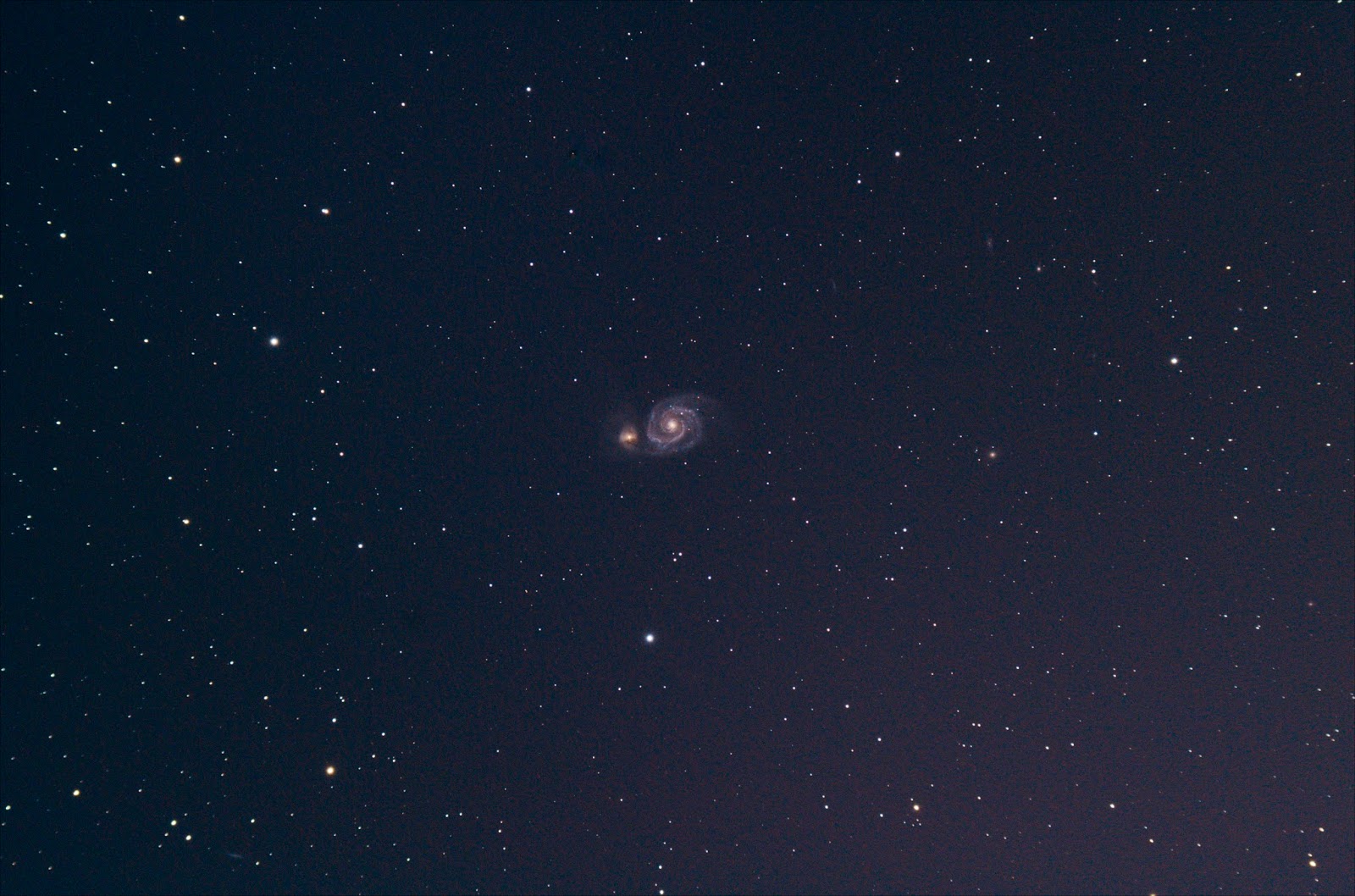
A very cold night, made worse by my mistaking Alioth for Mizar, throwing out the whole alignment.  This was compounded by not being able to focus the guide scope. I have mounted the telescopes on a larger  rail , so that I can balance them better. While doing this I thought I could remove an extension tube (duh!). So, after an hour, scopes finally aligned and focused and aimed at The Whirlpool Galaxy, M51. The moon was half full and in Orion, so the sky as pretty bright. I was limited to 60 s exposures. This image is based on 118 minutes of data. Pretty pleased with it, considering!

Messier 51 Whirlpool Galaxy

Enlargement to show the detail

Wednesday, 14 February 2018

Everyone photographs it...here is mine!

The best night of the year so far. No moon, almost no wind, dark and clear (and cold!). So, the three targets were:
1. Uranus. Could I identify it ?
2. M78 (unintentional but my mount will not do an automatic meridian flop, so I needed to target something across the meridian for an hour or so until my real target (Rosette) had crossed as well).
3. The real target for the night, the Rosette Nebula in Monoceros.

The results:

1. Uranus ...and Titania! Having checked the position using Astrometry.net, Cartes du Ciel and the Sky and Telescope Moons of  Uranus tool, this is a pretty confident result!

Uranus and Titania in Pisces

2. M78 in Orion. The bonus in this one was to get a bit of Barnard's Loop. At first I thought it was noise, but checking against other peoples (much better) photos, the red on the right is definitely part of the loop. Noisy image though, only based on 11 x 180 s exposures.

M78 and Barnard's Loop

3. La Piece de la Resistance !

The Rosette Nebula in Monoceros.


Friday, 2 February 2018

Under an almost full Blue Supermoon....

Beggars cannot be choosers. The first couple of clear nights in a while....and they fall under a 'blue' (second full moon in the month) , 'super' (closest to the Earth in its orbit) moon. So, I was only able to do shortish exposures (M81 etc and Horsehead were 60s, M78 and Hyades were 120 s).

M81, M82 and NGC3077

Part of the Hyades in Taurus

M78 in Orion, a reflection nebula

Horsehead and Flame nebulae in Orion

Wednesday, 10 January 2018

That's better! Orion Nebula and the Crab Nebula

I bought a 2 inch camera adapter and decided to try it without the 1 1/4 inch UHC filter I have been using. That proved it was the 1 1/4" assembly that was causing the terrible vignetting I was getting. The trouble is, light pollution is a problem and I wasn't able to take exposure of longer than 45s. So, I took a lot! Here are the two fruits of my endeavors, one more juicy than the other:


Orion Nebula M42 in Orion.     45 x 45s , plus lights, darks and bias

Crab Nebula M1 in Taurus. 150 x 45s , plus lights, darks and bias

The M1 photo is a heavy crop and the processing looks much poorer than the M42. I guess because its a fainter object and with my camera being ummodded plus the short exposures, there is not a lot fo data there really.

Next time.... my new 2" Baader Neodymium filter should have arrived so I can try the same with longer exposures.

Friday, 1 December 2017

Very Disappointing Results.

Having re read my copy of 'Capture every photon' again, I decided I had been using too high an ISO on the Nikon D5300 and so decided to drop it from 3200 to 800. After the usual trials and tribulations I ended up getting around 2 1/2 hours of data for M81/82 and about 1 1/2 for IC405 . The results:


HORRIBLE!!

There was an almost full moon, hence the realy bad gradient on the IC405 pic. However, though th e images are 'cleaner', there is much less detail. I think I will try 1600 ISO (though I might just go back to 3200!)


Monday, 13 November 2017

A very clear night

I now set up the telescope in the daylight, making sure the software is detecting the mount and the tracking cam. Once it is dark, I polar align the mount (hardly any adjustment needed usually). I then use 3 stars to align the mount , start taking the darks and check the tracking is ok. Then I can start getting the data I want.

Having decided to go for IC1396 in Cepheus, it turned out to be so close to the meridian it would require a 'meridian flip' - bad idea!. So I started with the Pleiades again. A change from previous sessions and showing my  'tracking confidence', I decided to go for 300s exposures. Compare this image with the previous one, based on 180 s exposures:

The Pleiades Open Cluster in Taurus

This is a cropped image. Despite taking flats, darks and bias,  the images  still show some vignetting. This might be because I changed the ISO when taking the bias  and flats. Note to self not to do it next time and see if that improves things

The main target, as I said above, was IC 1396 , a very large emission nebula in Cepheus. This contains within the 'famous' Elephant's Trunk nebula. plus a number of dark nebula.

Emission Nebula IC1396 (part of ) in Cassieopeia
I am not sure what caused the artefact top right, but overall I am pretty pleased with the image. There are several dark nebulae clearly visible  (clouds of dust blocking light from the stars behind). The Elephant's Trunk is centre bottom. The nebula is too bog to be captured with one field of view, but this is a good first try!

Saturday, 28 October 2017

Pleiades and the California Nebula

Another gap between sessions, largely caused by:
1. Weather, as ever
2. The USB-Serial link had packed up. This meant that I could not connect the PHD tracking software to the telescope. Two whole wasted sessions, plus a rebuild of the Windows 10 laptop until I worked out where the problem lay!

Anyway, after a surprisingly easy set up, I managed to get 30 x 180 s of the California Nebula in Perseus and 8 x 180 s of the Pleiades in Taurus:

California Nebula

Pleiades

Both would benefit from a lot more exposures . particularly the Pleiades since the nebulosity is barely visible. Not sure why I am getting the 'circle' effect; possibly because I forgot to take the bias pictures before taking the camera off, so attached it again in what I thought was the same orientation.