Tuesday, 29 October 2019

More Data and New Galaxies

Now that I have all the software issues resolved I can start doing longer exposures. First, I have  more data for the Fireworks Galaxy, so there is a better image. I also spent a couple of hours imaging NGC 678, 680 and IC 1730 in Aries.

Fireworks Galaxy

NGC 678, 680 and IC 1730 in Aries

Here is the plate solve from Astrometry:

Center (RA, Dec):(27.234, 21.926)
Center (RA, hms):01h 48m 56.262s
Center (Dec, dms):+21° 55' 32.561"
Size:56.9 x 37.9 arcmin
Radius:0.569 deg
Pixel scale:0.715 arcsec/pixel
Orientation:Up is 65.9 degrees E of N


Wednesday, 23 October 2019

Fireworks Galaxy, Uranus and Neptune

NGC 6946 also known as the Fireworks Galaxy is a face-on intermediate spiral galaxy with a small bright nucleus, whose location in the sky straddles the boundary between the northern constellations of Cepheus and Cygnus. Its distance from Earth is about 25.2 million light-years.


The Fireworks Galaxy in Cepheus

This is based on 10 x 240 s exposures. These are the longest I have managed with the new set up. I have finally solved the problem of mysterious tracking errors;  if I use AstroPhotography Tool dithering, then  it seems to upset PHD2. Using PHD2 dithering sorts it out. Apart from that, the other problem last night was dew ; I have a dew shield and Astro Zap dew band, but it is not the right one for the scope and there is nothing on the guider.

I also took more images of Uranus and Neptune.

The movement of Neptune between 16 Oct 2019 and 22 Oct 2019

The movement of Uranus between 16 Oct 2019 and 22 Oct 2019

Comparing the two tracks of the planets, one is moving in the opposite direction to the other (presumably one is retrograde at the moment, with respect to the movement of the Earth). Also, the apparent movement of Neptune is less than that of Uranus, presumably reflecting the much greater distance to Neptune from Earth.
The distance of Uranus from Earth is currently 2,819,977,014 kilometres, equivalent to 18.850382 Astronomical Units.

The distance of Neptune from Earth is currently 4,354,863,649 kilometres, equivalent to 29.110465 Astronomical Units.


Moons of Uranus
This shows some of the moons of Uranus (Titania, Miranda , Ariel, Umbriel, and Oberon). Apparently Umbriel and Ariel are often lost in the glare of the planet. The Sky and Telescope tool shows this for the time the photo was taken:


So, I am not sure which is which! If the glare in my photo is really large then maybe Miranda, Ariel and Umbriel are almost lost in it ?

Thursday, 17 October 2019

New Mount and Telescope - almost there

No real astrophotography in a while , because I have been getting the new mount and telescope sorted out. It is now calibrated, points to the right places, camera works, guiding works, so, just need some decent weather, as always.

The new setup is:

1. Pillar mount
2. Skywatcher EQ6 R Pro mount
3. Celestron 9.25 XLT with focal reducer, so it is working at around F6.8
4. Canon 500D astro modded DSLR
5. QHY 5iiC in a modified Skywatcher guidescope

The software is Ascom/Eqcom - so  the pc/camera/mount can talk to each other
Carte du Ciel - to point the telscope
PHD2 for guiding
AstroPhotography Tool, to connect the camera to everything (imaging, focussing, dithering, etc)

Here are more 'snapshots':

Dumbbell Nebula

Gibbous Moon

Little Dumbbell Nebula

Neptune

Uranus

Uranus

Friday, 6 September 2019

September Tour


And following the theme...
All single shots, exposures up to 30 s.

NGC 6939 and NGC 6946 in Cepheus
The next one is particularly interesting, a double star only about 11 light years from Sol. It is close enough to show parallax and is moving fast enough that in 6 years, the pair will have moved 'one pair width' against the background. So , in six months I shall see if I can image it and measure the parallax!

61 Cygni

Albireo 

Dumbbell Nebula Vulpecula
 This is a very short exposure, since any longer ones overexposed the two stars and the double could not be seen.
Gamma Delphini

M17 Swan Nebula

M56 Globular Cluster in Lyra

M71 Globular Cluster in Sagitta

NGC 7063 Open Cluster in Cygnus 

Not terribly exciting, but the blob in the middle is not a star but is the very compact 'Blinking Nebula' It gets the name since it is best seen using averted vision, when you look at it directly in a telecope it tends to 'disappear'.
The Blinking Nebula
 NGC 6826 in Cygnus

Saturday, 24 August 2019

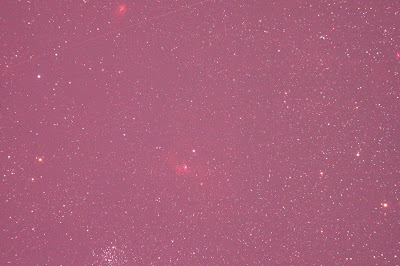
August Sky Tour - Cepheus and Cassiopeia


Around 30s exposure, single frame, 1600 ISO, apart from the Wizard nebula , which was 6 x 240 s.

So, I saw:


NGC 7789 Caroline's Rose - Open Cluster


M52 Open Cluster


NGC 7635 Bubble Nebula

NGC 7510 Open Cluster


NGC 7380 Wizard Nebula


NGC 7354 Planetary Nebula


Friday, 2 August 2019

A quick tour

I had a go at following a Sky at Night Deep Space tour, for July. Only single exposures, all at ISO 1600 and between 30 and 240 seconds.

Barnard 142 and 143 in Aquila (Dark Nebula)

M56 Globular Cluster in Lyra

M57 Ring Nebula in Lyra

Minkowski Planetary Nebula in Lyra

NGC 6765 Planetary Nebula in Lyra

Stephenson 1 Open Cluster in Lyra

Eagle Nebula in Aquila

NGC 6781 Planetary Nebula in Aquila

Friday, 31 May 2019

Some activity in white light

I have finally seen some activity on the Sun on white light. The image shows faculae (just, if you squint !). This faculae are visible in a number of images taken over several minutes, so are not figments of my imagination.These are brighter than  normal areas and can be associated with sunspots (cooler than normal areas). According to Spaceweatherlive a sunspot group is due to appear from the side of the Sun away from the Earth any day now, so maybe this is preceding it.